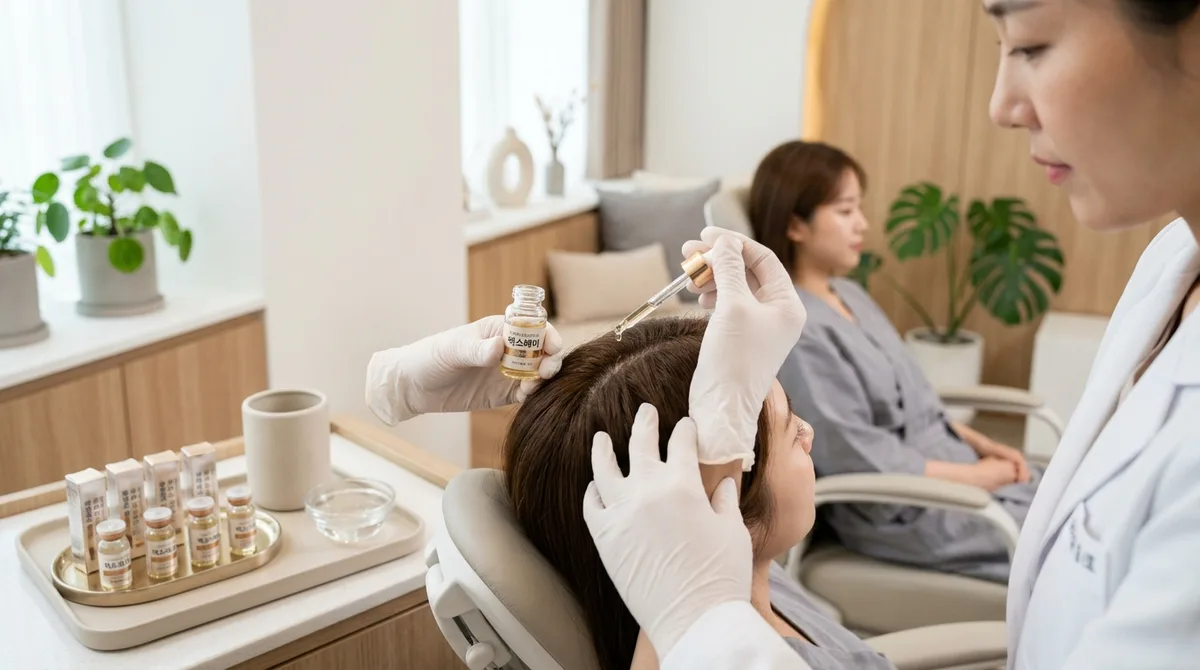
Korean scalp clinics have quietly moved past PRP. Walk into a dermatology practice in Gangnam or Busan this year and the vial waiting on the tray is more likely to hold lyophilized exosomes: freeze-dried signaling particles harvested from stem cells or plant cultures, reconstituted minutes before your scalp treatment.
Exosomes are nano-sized vesicles, roughly 30 to 200 nanometres, that cells use to talk to each other. In the scalp they carry growth factors, peptides, and microRNAs that nudge dormant follicles back toward the growth phase, settle inflammation, and improve the environment around the root. That is the pitch. The reality is more measured, and worth understanding before you book.
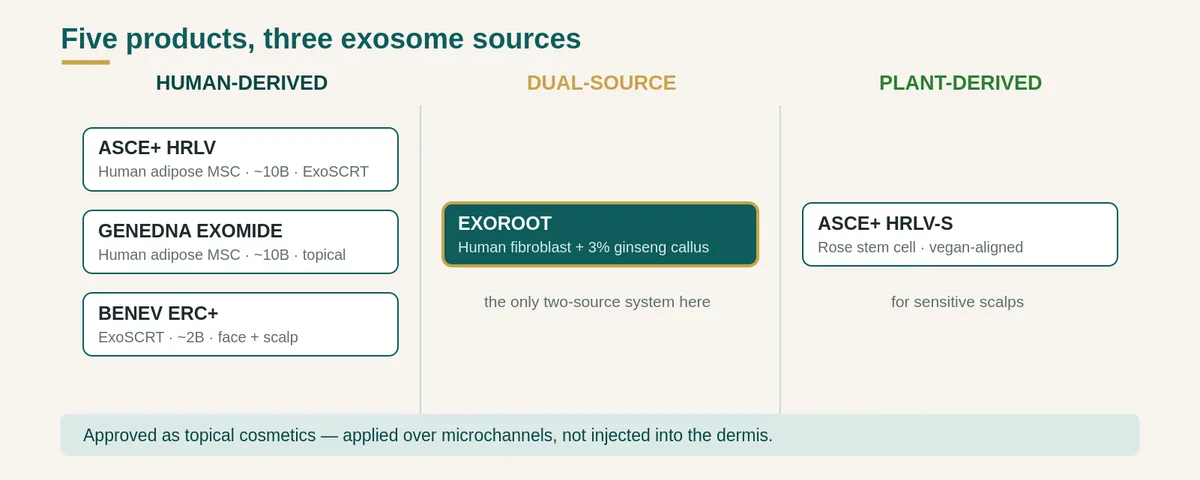
Here are the five hair exosome products Korean clinics reach for in 2026, what sets each apart, and how to read the marketing around them.
Why clinics moved past PRP
PRP draws your own blood, spins it, and injects the platelet layer back into the scalp. It works for some people, but the dose of growth factors varies with whoever is in the chair that day. Exosome products give a clinic a standardised, lab-purified dose every session. One London and Barcelona dermatologist who ran a two-year scalp study with an exosome product described it as outperforming older options like oral dutasteride, minoxidil, and PRP, and noted it held up in the frontal scalp, the area where many treatments stall.
That is one clinician's view, not a guarantee. But it captures why the category took off in Korea: consistency, no blood draw, and a formula a clinic can pair with the microneedling and laser tools already in the room.
How Korean clinics use exosomes on the scalp
Almost every product here arrives as two parts: a freeze-dried exosome powder and a separate solution. The clinician mixes them on the spot, because exosomes lose activity once reconstituted. The blend then goes onto the scalp through microchannels created by microneedling, a mesogun, or an MTS roller, or it is layered on after RF microneedling and laser.
One honest caveat up front. In South Korea and most countries, these products are approved as topical cosmetics, not injectables. Intradermal injection is an off-label practice, and dermatology journals have documented adverse reactions, including necrosis and granulomas, when unregulated exosome formulas were injected into the dermis. A careful clinic uses them topically over microchannels rather than as a deep injection. Keep that in mind when you compare offers.
1. EXOROOT — the dual-source scalp system
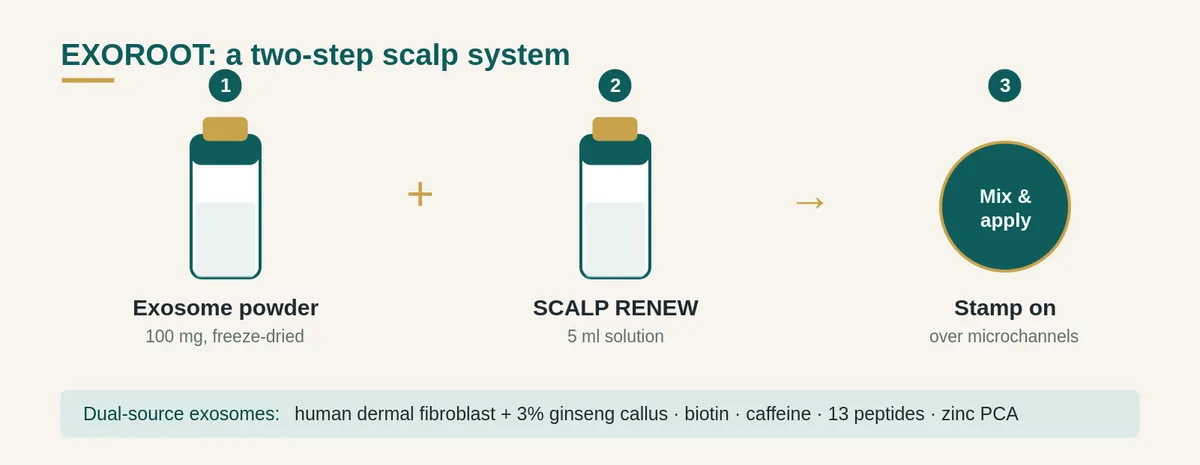
EXOROOT stands out for one structural reason: it is the only product here that combines two exosome sources in a single vial. Its lyophilized powder pairs human dermal fibroblast-derived exosomes, which support cellular renewal and repair of the follicle micro-environment, with 3% ginseng callus exosomes, a plant source rich in phyto-growth factors.
The system ships as 100 mg of freeze-dried exosome powder plus a 5 ml SCALP RENEW solution. You add the full solution to the powder and mix until the blend turns clear and watery, then apply it with gentle stamping motions over the treated zones. The powder is freeze-dried at minus 80 degrees Celsius to hold its structure until the moment of use.
The supporting formula is built for the scalp rather than borrowed from a skin product: sodium hyaluronate for hydration, panthenol to soothe, biotin to strengthen follicles, caffeine to stimulate microcirculation, zinc PCA to balance an oily or congested scalp, and a 13-peptide complex for structural support. It is compatible with the full range of in-clinic delivery, from mesotherapy and microneedling to mesoguns, RF, LED, laser, and ultrasound.
Best for: clinics that want one product covering both regenerative signalling and everyday scalp health, and patients who like human and plant exosomes working together rather than choosing one side.
2. ASCE+ HRLV — the clinical heavyweight
If EXOROOT is the all-rounder, ExoCoBio's ASCE+ HRLV is the name with the deepest paper trail. ExoCoBio is one of the larger exosome manufacturers globally, has filed more than 40 patents, and registers its ASCE+ line as a cosmetic in Korea, the US, and Europe.
HRLV uses human adipose-derived mesenchymal stem cell exosomes isolated through the company's ExoSCRT process. Each 20 mg vial delivers around 10 billion exosomes alongside more than a thousand growth proteins, hundreds of anti-inflammatory microRNAs, 0.05% biotin, and copper tripeptide. Clinicians reconstitute the powder with saline or diluent, then apply it over microneedled scalp.
It turns up repeatedly in published case work, including androgenetic alopecia, scarring alopecia, and refractory beard alopecia. That does not make it magic, but it does mean dermatologists have documented how it behaves on real patients.
Best for: patients who want the most-studied human-derived option, and clinics treating harder cases such as scarring or autoimmune-related hair loss under medical supervision.
3. BENEV Exosome Regenerative Complex+ — the dual-action workhorse
BENEV's ERC+ is the product many international clinics standardise on, and it is built on the same ExoSCRT exosome technology that runs through the Korean exosome category. Each treatment unit pairs 20 mg of lyophilized exosomes with a 5 ml diluent and delivers roughly 2 billion exosomes, plus growth factors, peptides, coenzymes, minerals, amino acids, and vitamins.
It is designed for both skin and scalp, which is why you see it used after RF microneedling on the face and along the hairline in the same practice. There is an active clinical trial evaluating ERC+ after RF microneedling specifically for self-perceived thinning hair, run across four monthly sessions. The product needs cold-chain storage, refrigerated and shipped on ice, and carries a two-year shelf life when kept properly.
Best for: clinics that want one exosome system for face and scalp, and patients combining hair work with RF microneedling.
4. GENEDNA EXOMIDE — the accessible adipose option
EXOMIDE, made in South Korea by Genedna, is a topical exosome treatment offered in skin and hair versions. The hair formula carries 10 billion exosomes per treatment, drawn from human adipose-derived mesenchymal stem cell cultures. It is built to increase follicle and hair-root cell activity, normalise the growth cycle, and add anti-inflammatory and collagen-supporting effects at the scalp.
Clinics typically apply it topically and drive it in with a microneedling pen. It is a straightforward single-source human exosome product without the flagship-brand premium, which makes it a common pick for clinics building out an exosome menu at a more accessible price.
Best for: patients who want a human-derived exosome treatment without the top-brand cost, and clinics wanting a reliable topical workhorse.
5. ASCE+ HRLV-S — the plant-derived alternative
Rounding out the list is HRLV-S, ExoCoBio's rose stem cell version of its hair line and a deliberate sibling to the adipose-based HRLV at number two. Where standard HRLV uses human exosomes, HRLV-S is built on rose stem cell-derived exosomes, a plant source. It appears in published work too, including a male androgenetic alopecia case treated with rose stem cell exosomes delivered by needle-free electroporation, and a study on gray-hair repigmentation.
The plant route matters for two groups: patients who prefer a vegan-aligned, non-human-derived option, and those with sensitive scalps who want regenerative signalling without an animal or human-cell source. If you are weighing plant versus human exosomes, that choice deserves its own read. See: Plant or Human Exosomes — what Korean clinics are choosing.
Quick comparison
| Product | Exosome source | Format | Best for |
|---|---|---|---|
| EXOROOT | Human fibroblast + ginseng callus (dual) | 100 mg powder + 5 ml solution | All-round scalp + regeneration |
| ASCE+ HRLV | Human adipose stem cell | 20 mg (~10B) + diluent | Most-studied; harder cases |
| BENEV ERC+ | Stem cell-derived (ExoSCRT) | 20 mg (~2B) + 5 ml diluent | Face + scalp in one system |
| GENEDNA EXOMIDE | Human adipose stem cell | Topical, ~10B (hair) | Accessible human-derived |
| ASCE+ HRLV-S | Rose stem cell (plant) | 20 mg powder + diluent | Vegan-aligned / sensitive |
How an exosome actually works on hair
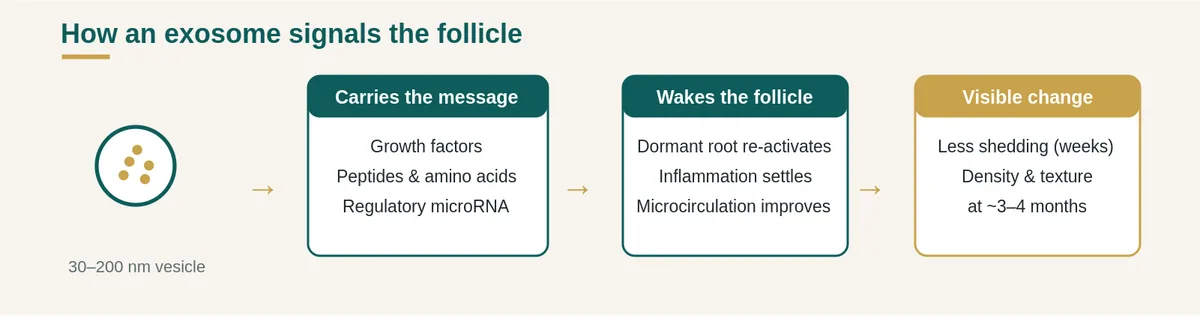
The mechanism is the same across every product on this list, regardless of source. A reconstituted exosome is a tiny vesicle carrying a cargo of growth factors, peptides, and regulatory microRNA. Delivered through microchannels, it reaches follicle cells and hands over that cargo. The follicle responds by re-activating dormant roots, calming local inflammation, and improving the blood supply around the bulb. Over a treatment course, more follicles shift back into the active growth phase, which is what shows up as reduced shedding and, later, more density.
What results actually look like
Exosome scalp therapy is a course, not a single visit. Korean clinics generally run three to five sessions spaced two to four weeks apart. Most patients notice reduced shedding and a healthier-feeling scalp within the first few weeks, with visible changes in density and texture around the three-to-four-month mark as treated follicles cycle into a new growth phase.
It works best as part of a plan, alongside microneedling or RF and often beside oral or topical medication, rather than as a standalone fix. Anyone promising overnight regrowth from a single vial is selling the hype, not the science.
Choosing well
- For a clinic building a menu, EXOROOT covers the most ground in one product.
- For documented, medically supervised cases, ASCE+ HRLV has the literature.
- For a face-and-scalp practice, BENEV ERC+ fits in one system.
- For accessible human-derived treatment, GENEDNA EXOMIDE delivers.
- For a plant-based route, ASCE+ HRLV-S exists for exactly that reason.
If you are researching exosome treatment for your own hair, bring this list to your consultation and ask three things: which product the clinic uses, where the exosomes come from, and whether they apply it topically over microchannels rather than injecting it into the scalp. The answers tell you a lot about the clinic.
Curious how plant and human exosomes really differ once they reach the follicle? That comparison is worth a read before you book. Either way, ask your clinic to name the exosome on the tray.