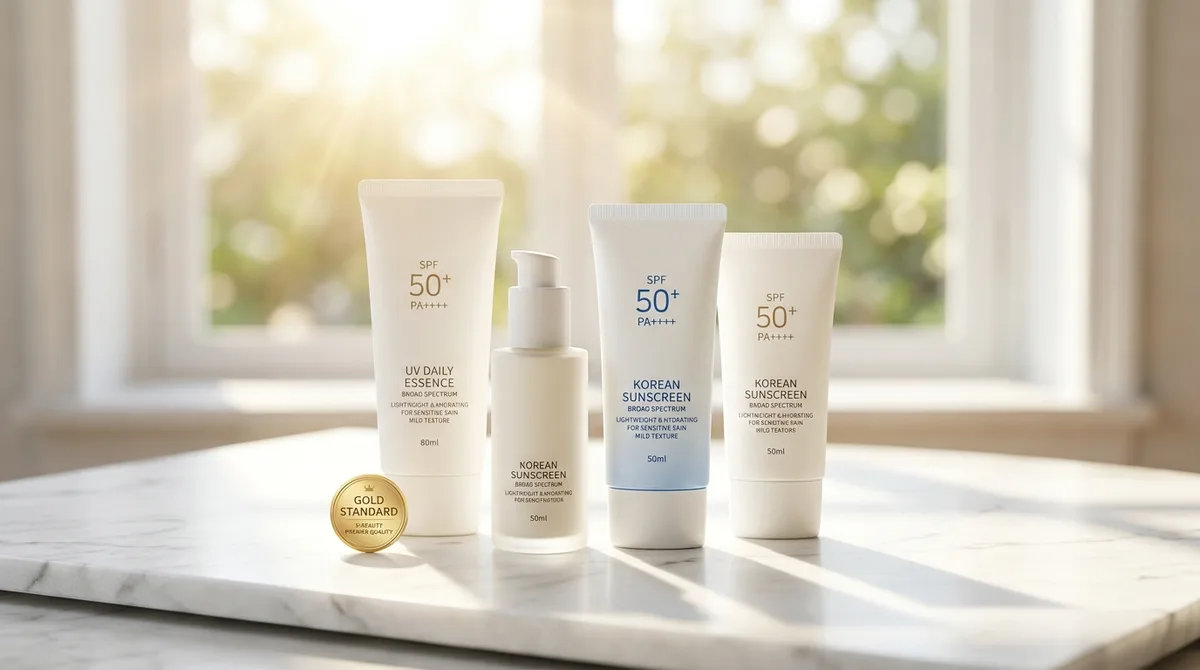
Ask a skincare obsessive in New York, London or Sydney what is in their bathroom cabinet and there is a good chance the sunscreen is Korean. K-beauty SPF has become the one product the global skincare community agrees on, the thing people stuff into suitcases coming back from Seoul and reorder online at a premium. That reputation is not hype or marketing. It rests on a real, documented gap in the science, and on a culture that treats sun protection as the most important step in skincare rather than an afterthought.
Here is why Korean sunscreen earned its gold-standard status, how to read the label, how to pick the right one for your skin, and the one honest caveat worth knowing before you buy.
The real reason: better filters
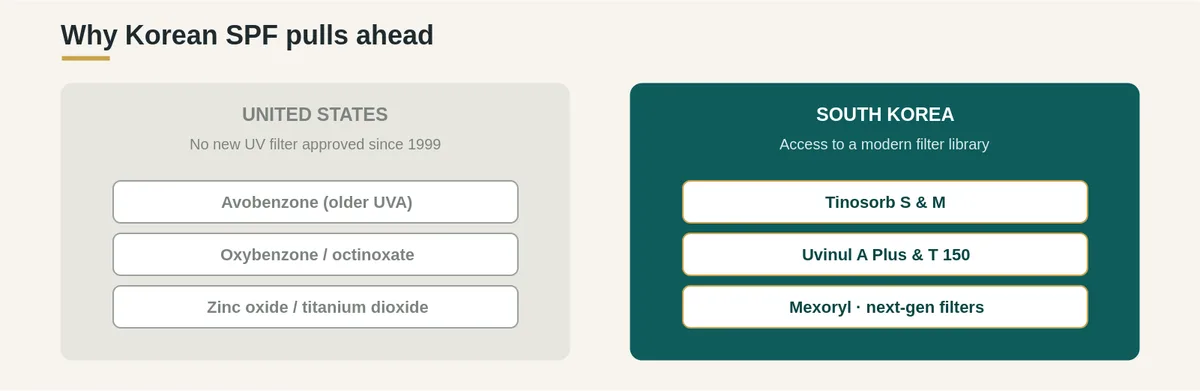
The single biggest advantage comes down to UV filters, the active ingredients that actually block radiation. The United States Food and Drug Administration has not approved a new chemical UV filter since 1999. American sunscreens are largely built on an ageing toolkit, leaning on filters like avobenzone and oxybenzone that have real limitations in UVA coverage and photostability.
South Korea, along with Japan and the European Union, allows a far wider and more modern library of filters. Names like Tinosorb S, Tinosorb M, Uvinul A Plus, Uvinul T 150 and Mexoryl are standard in Korean formulas and unavailable in American ones. These newer filters provide stronger, more stable UVA protection with less irritation, and they work at lower concentrations, which is exactly why Korean sunscreens can be both more protective and dramatically lighter on the skin. The practical result is that a Korean chemical sunscreen often outperforms a US one on UVA coverage even at the same SPF number.
Real UVA protection, clearly labelled
The second advantage is how Korea communicates protection. The SPF number everyone knows only measures UVB, the rays that burn the surface of the skin. But UVA rays penetrate deeper, driving premature ageing, dark spots, and certain skin cancers, and for decades Western labels barely addressed them. The United States still uses a single binary phrase, broad spectrum, that tells you very little about how much UVA defence you are getting.
Korea uses the PA system, developed in Japan and based on a UVA-specific test, rating protection from PA+ up to PA++++. Each additional plus signals progressively higher UVA absorption, so a label reading SPF 50+ PA++++ tells you in two short codes that you are well covered against both burning and ageing rays. It is a more honest, more complete picture than most Western labels provide.
Decode the label
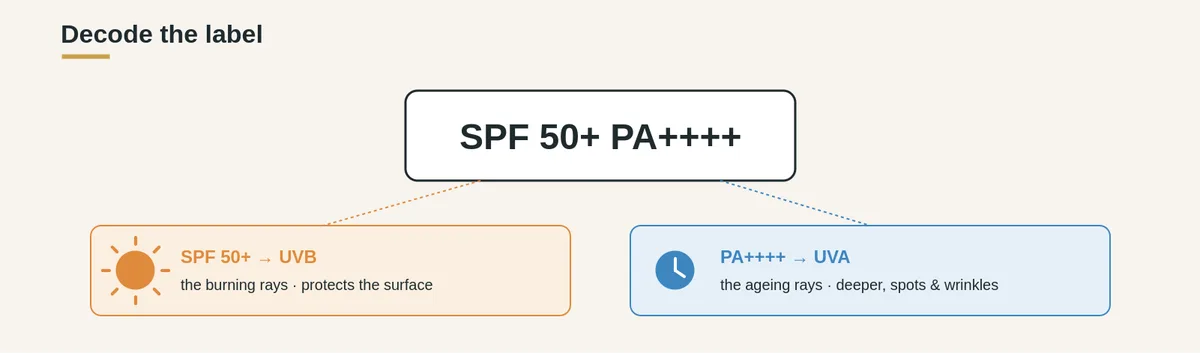
| On the label | Protects against | What it means |
|---|---|---|
| SPF 50+ | UVB rays | The burning rays; the number maxes out usefully around 50 |
| PA++++ | UVA rays | Ageing, dark spots, deeper damage; more plusses = more UVA cover |
| Broad spectrum | UVA + UVB | The Western binary label; less precise than the PA system |
Sunscreen that feels like skincare
Science aside, the reason people fall in love with Korean SPF is how it feels. Because the modern filters work at low concentrations, formulators can build sunscreens that are fluid, weightless, and fast-absorbing rather than thick and greasy. The dreaded white cast, the ghostly residue that has long made sunscreen unpleasant on deeper skin tones, is minimal or absent thanks to fine-suspension filters. Korean SPF wears beautifully under makeup and often replaces a moisturiser entirely.
Korean brands also treat sunscreen as a skincare step in its own right, blending in actives like centella, hyaluronic acid, niacinamide, and rice extract so the product hydrates, soothes, or brightens while it protects. A sunscreen that doubles as a treatment, and feels good enough to want to reapply, is a sunscreen people actually use, which is the entire point. Protection you skip because it feels horrible protects nothing.
How to choose for your skin
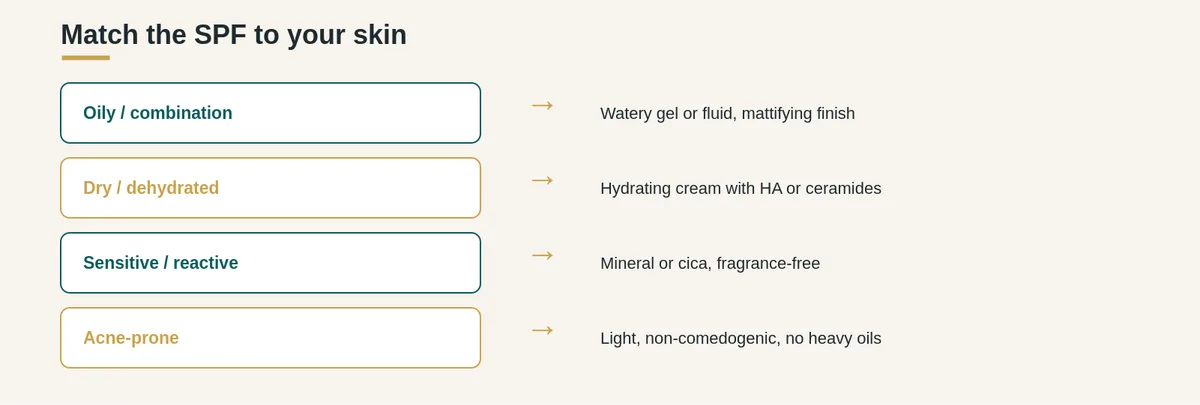
With hundreds of excellent options, the choice comes down to texture and skin type rather than protection level, since most quality Korean sunscreens already sit at SPF 50+ PA++++. Oily and combination skin does best with a watery gel or fluid that mattifies. Dry skin wants a hydrating cream with ingredients like hyaluronic acid or ceramides. Sensitive or reactive skin should look to mineral or cica-based formulas that are fragrance-free, and acne-prone skin needs something light and non-comedogenic without heavy oils. Tone-up versions add a subtle brightening tint for a no-makeup glow, while sun sticks make reapplication over makeup effortless.
Apply it right, or it won't work
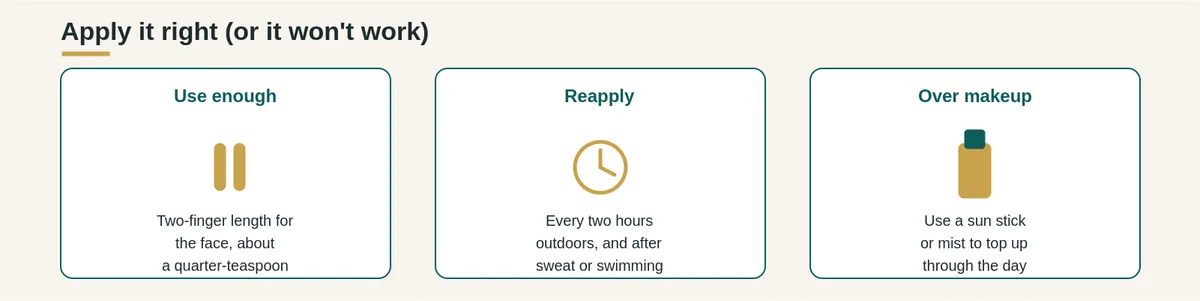
Even the best sunscreen fails if you under-apply it, which most people do. The protection on the label assumes a generous, even layer. For the face, the simple guide is the two-finger rule, a strip of product along the length of two fingers, or roughly a quarter-teaspoon. Apply it as the final step of your morning routine, after skincare and before makeup, and let it set for a few minutes. Reapply every two hours when you are outdoors, and after sweating or swimming. A sun stick or mist is the easy way to top up over makeup during the day.
The honest caveat: can you trust the SPF?
No guide worth reading would skip this part. Korean sunscreen had a credibility scare in 2020 and 2021, when independent testing of the wildly popular Purito Centella Green Level Unscented Sun, labelled SPF 50+, returned results closer to SPF 19. The Korea Institute of Dermatological Sciences later tested it at 28.4, still well short of the claim. Purito recalled and reformulated, and a few other brands were caught up in the fallout.
It would be easy to read that as a Korea problem, but the truth is broader and more reassuring. SPF testing is an inherently messy science everywhere: the standard test measures skin redness on a small group of people, results vary widely between labs, and there is documented bias when a lab is told the number a brand is hoping for. The same P&G experiment that exposed this sent identical samples to five labs and got back SPF readings ranging from 37 to 75. Western brands fail independent SPF tests too. Different countries also use different test standards, so the same product can score differently depending on where it is assessed.
The sensible takeaway is not to distrust Korean sunscreen, which remains excellent and rigorously regulated under Korea's functional-cosmetics system, but to be a smart consumer of any sunscreen. Buy from established, reputable brands, apply more than you think you need, reapply, and do not rely on a high number as a licence to bake in the sun. Sunscreen is one layer of sun protection, alongside shade, hats, and timing.
Protect what's underneath
There is one more reason to take this seriously, especially for this audience. If you invest in your skin, whether that is a careful routine built on Korean plant-based actives or in-clinic treatments like exosome therapy, UV exposure is the fastest way to undo the results. Freshly treated skin is more photosensitive, and unprotected sun erodes the brightness, evenness, and firmness those treatments work to build. Daily SPF is not a separate concern from your skincare; it is the step that protects everything else you do.
The takeaway
Korean sunscreen deserves its gold-standard reputation. It is built on better filters than American formulas can legally use, it labels UVA protection honestly through the PA system, and it is engineered to feel good enough that people actually wear it every day. Pair a well-chosen SPF 50+ PA++++ formula with a generous application and sensible habits, and you have the most effective anti-ageing and skin-cancer-prevention step in all of skincare. It also happens to be the one step Seoul never skips.
Sun protection is the non-negotiable final step in every modern Korean routine, which is exactly why it survived the shift to minimalist skip-care. Build the rest of your routine around it and your skin will thank you for years.