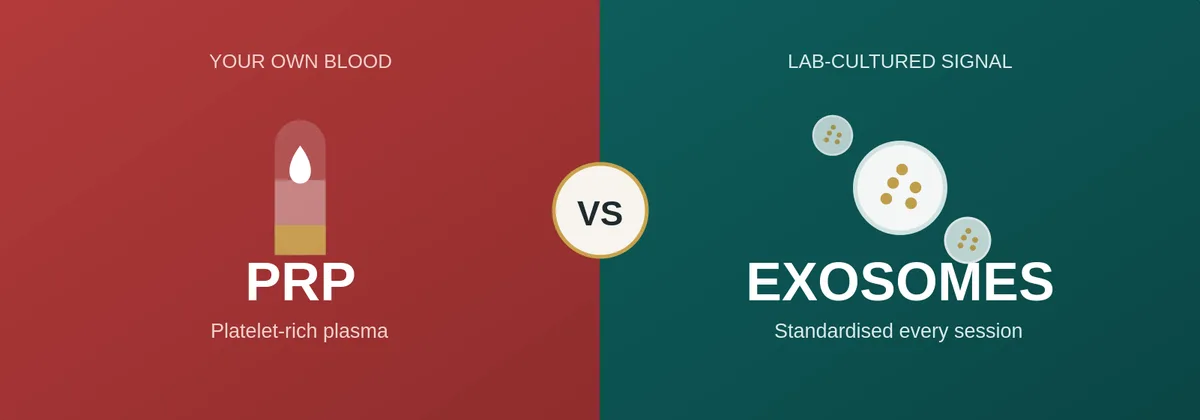
Two vials, two philosophies. One is spun from your own blood minutes before it goes back into your skin. The other is grown in a lab and arrives as identical, standardised particles every single time. PRP and exosomes are the two regenerative treatments every Korean clinic now offers for skin and hair, and patients keep asking the same thing: which one actually wins?
The honest answer is that it depends on what you are optimising for. Here is the fair version, without the clinic markup.
What PRP actually is
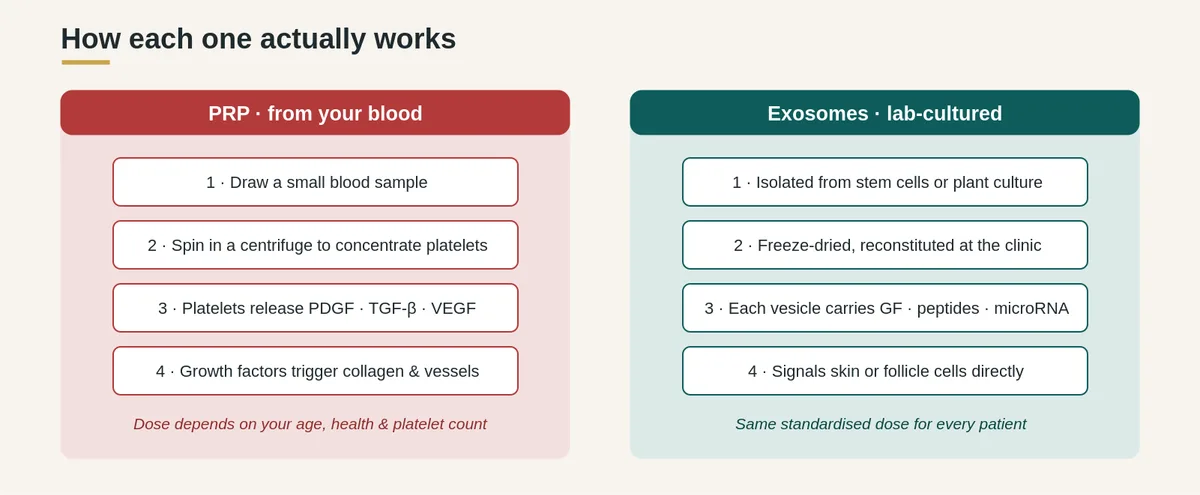
Platelet-rich plasma is the older of the two and the more established. A clinician draws your blood, spins it in a centrifuge to concentrate the platelets, and reintroduces that platelet layer into your scalp or skin, usually after microneedling. On the face, that combination is the treatment marketed as the vampire facial.
Platelets carry growth factors such as PDGF, TGF-beta, and VEGF, which trigger collagen synthesis, new blood-vessel formation, and cell proliferation in the treated tissue. Because it is your own blood, PRP is autologous: there is no foreign material, which gives it a favourable safety profile in trained hands.
Its strength is also its limit. The dose of growth factors you get depends on your age, health, and platelet count on the day, so results vary from person to person and even session to session. A fit 30-year-old and a stressed 55-year-old can walk out of the same clinic with very different vials, because the raw material is their own blood.
The patient experience is straightforward but not glamorous. There is a needle for the blood draw, the spin takes a few minutes, and the reintroduction leaves mild redness and slight swelling for a day or two. Decades of use have made the protocol routine, and because nothing foreign goes in, allergic or immune reactions are rare.
What exosomes actually are
Exosomes take the opposite route. Instead of harvesting signals from your blood, they are isolated from cultured stem cells or plant sources in a lab, freeze-dried, then reconstituted at the clinic. Each nano-sized vesicle carries a broad cargo of growth factors, cytokines, peptides, and regulatory microRNA, and because it is manufactured, the potency is standardised regardless of who is in the chair.
This is the category Korean clinics have leaned into hardest. Scalp systems like EXOROOT and plant-exosome skin treatments such as EXO NAD+ are built to deliver a consistent regenerative signal every time, applied over the microchannels created by microneedling.
That standardisation is the real selling point. A clinician knows roughly what each vial delivers before it touches your skin, which removes the patient-to-patient lottery built into PRP. Exosomes are often described as molecular postmen: rather than flooding tissue with raw growth factors, they hand specific instructions to skin or follicle cells, telling them to build collagen, calm inflammation, or improve blood supply.
The catch: exosomes carry no FDA approval for aesthetic use anywhere as of 2026, and in Korea they are cleared as topical cosmetics rather than injectables. Quality also varies between manufacturers, so where the product comes from matters more than it does with PRP. A pharmaceutical-grade exosome from a tightly controlled lab and a cheap unverified one can look identical in the vial and behave nothing alike on your scalp.
Skin: collagen, glow, and recovery
For skin rejuvenation, PRP has the deeper evidence. Multiple randomised controlled trials support it, and one histologic study reported an 89% improvement in dermal collagen density in treated areas. If you want a treatment with years of trial data behind it, PRP is the safer bet on paper.
Exosomes answer on experience and consistency. Two systematic reviews published in early 2026 found positive associations for skin elasticity, hydration, and wrinkle depth, while both stressed that larger standardised trials are still needed. In clinic, patients tend to report faster healing and less redness after exosomes than after PRP.
The two also tend to do different jobs best. PRP is strong on structural rebuilding, driving collagen and firmness over a course of sessions. Exosomes lean toward calming and recovery, which is why clinics reach for them after lasers or aggressive resurfacing, where reducing redness and speeding healing matters as much as long-term collagen.
Modern plant-exosome skin systems push the numbers further. EXO NAD+, for instance, reports a 39.78% rise in dermal density, 28.56% in elasticity, 22.40% in hydration, and a 17.89% reduction in wrinkles over four weeks. Those are manufacturer figures rather than independent trials, so read them as a product claim rather than a peer-reviewed result, but they show where the category is aiming.
Hair: the regrowth question
On the scalp, PRP again has the longer track record. Studies generally show 60 to 80 percent of patients with pattern hair loss see some improvement, with initial change around three to four months and fuller results by six to twelve. It is a proven, if gradual, option.
Exosomes are the newer contender, and the early head-to-head data is interesting. A 2025 systematic review confirmed the therapeutic potential of stem cell-derived exosomes for hair regeneration, and small case work has shown exosomes producing meaningful improvement after a single session, sometimes outpacing PRP. Those studies are small and not always matched, so treat them as promising rather than settled. There is also an active randomised trial comparing the two directly for androgenetic alopecia.
One dermatologist who ran a two-year scalp study with an exosome product described it as outperforming older options including oral dutasteride, minoxidil, and PRP, and noted it held up in the frontal scalp, the zone where many treatments stall. That is one clinician's view rather than a guarantee, but it captures why Korean clinics keep stocking exosome scalp kits: a standardised dose, no blood draw, and a short course that slots in beside the microneedling tools already in the room.
For clinics that want a standardised scalp product, dual-source systems like EXOROOT pair human and plant exosomes in one vial, applied over microchannels in a short course. See: Top 5 Hair Exosome Products Used in Korean Clinics.
The honest scorecard
| Factor | PRP | Exosomes |
|---|---|---|
| Source | Your own blood (autologous) | Lab-cultured stem cell or plant |
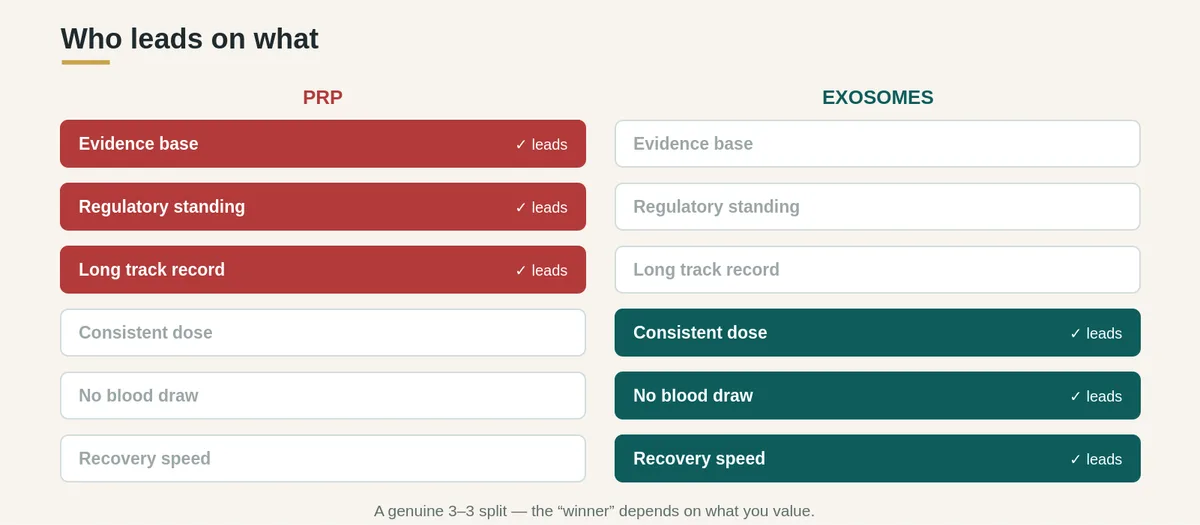
| Consistency | Varies with your health | Standardised every session |
| Evidence base | Larger; multiple RCTs | Growing; fewer large trials |
| Regulatory standing | Clear; devices FDA-cleared | No FDA aesthetic approval (2026) |
| Recovery | Mild redness, slight swelling | Often quicker, less redness |
| Blood draw | Required | None |
| Sessions | 3–6, every 4–6 weeks | Short course, 2–4 weeks apart |
| Typical cost (skin) | $500–$1,500 / session | $750–$1,200+ / session |
Safety: the part the brochures skip
On safety, the source is the whole story. PRP is your own blood, so the main risks are bruising and the discomfort of the draw, and serious reactions are uncommon when a trained clinician runs it. Exosomes are a manufactured product, which makes sourcing and how they are used the variables that matter.
The clearest caution sits with injection. Exosome products are approved for topical use over microchannels, not for deep dermal injection, and dermatology journals have documented adverse reactions, including necrosis and granulomas, when unregulated exosome formulas were injected into the skin. A careful clinic applies them topically after microneedling rather than injecting them deep. If a clinic offers to inject exosomes into your dermis, that is your cue to ask exactly what product they are using and why.
Cost and commitment
Pricing overlaps more than the marketing suggests. PRP facials generally run $500 to $1,500 a session and PRP hair restoration $800 to $2,000, while exosome sessions sit around $750 to $1,200 and up. Both are courses, not one-offs. PRP usually means three to six sessions spaced four to six weeks apart with periodic maintenance, while exosome protocols often run a tighter course of three to five sessions every two to four weeks.
Why you might not have to choose
The cleanest answer in 2026 is that the two are not really rivals. Many clinics layer exosomes on top of microneedling or PRP in the same visit, using the microchannels to drive the exosome signal deeper while the needling or PRP primes the tissue. If your budget allows, the combination captures PRP's proven groundwork and the exosome's standardised signal in one sitting.
So which wins?
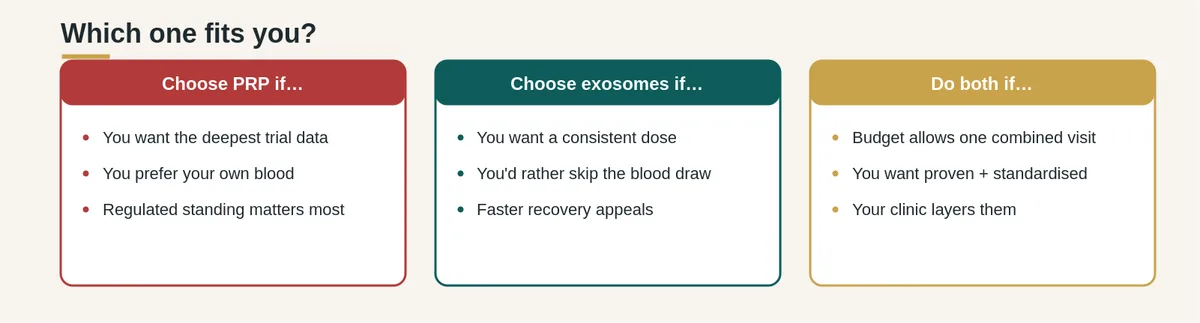
If your priority is the deepest evidence base and a regulated, autologous treatment, PRP wins. If you want a consistent dose, faster recovery, no blood draw, and you are comfortable with a newer category, exosomes win. For most people the deciding factors are practical: whether you mind a blood draw, how much you value trial data over convenience, and what your clinic actually stocks.
Before you book, ask the clinic three things: which exact product they use, where it is sourced, and whether they apply it over microchannels or inject it. The answer tells you as much as any brochure. If you are leaning exosome, it is worth understanding how plant and human exosomes differ before you choose a clinic.