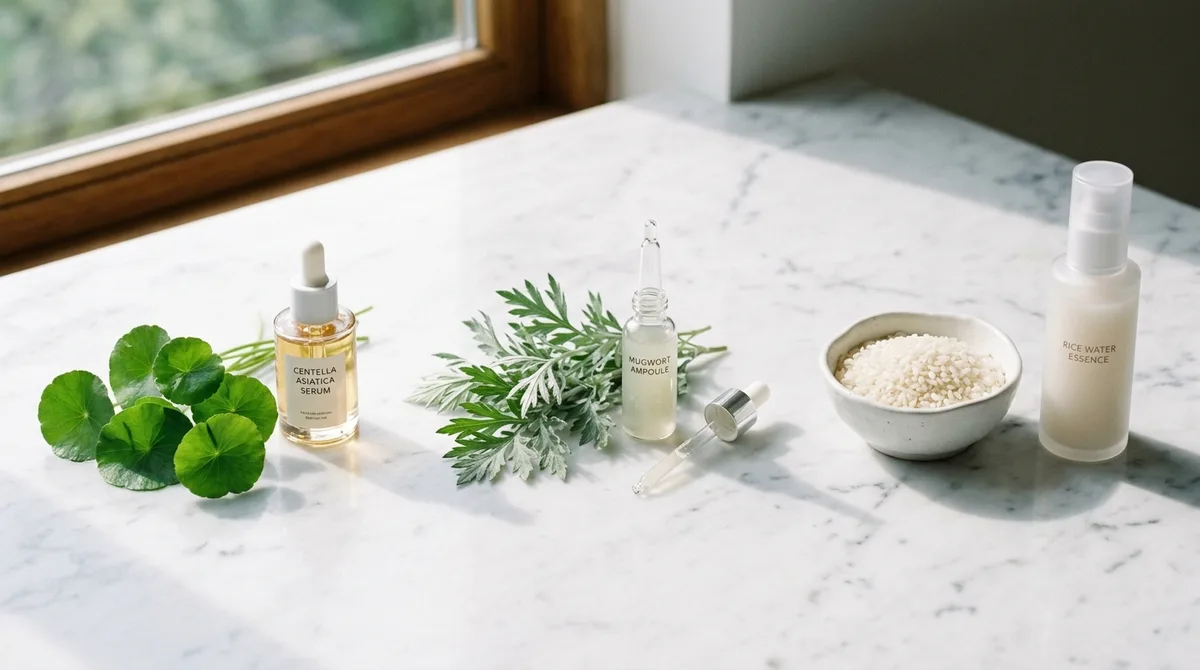
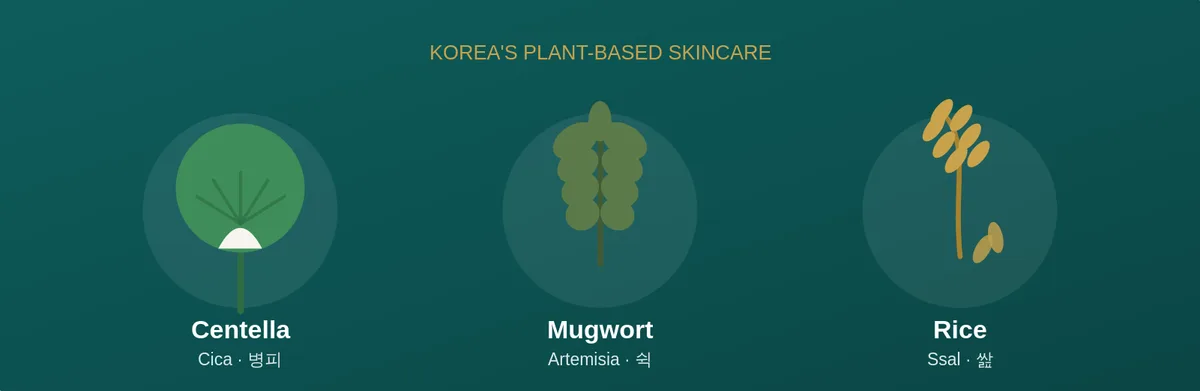
Open a Korean grandmother's kitchen cabinet and you will find three things that also sit, in refined form, on Seoul's most advanced skincare shelves: a round-leafed herb, a feathery grey-green weed, and a bag of rice. Centella, mugwort, and rice have been part of Korean healing and beauty for centuries, long before the K-beauty boom gave them INCI names and 80%-extract ampoules.
What separates these three from the hundreds of plant extracts that crowd ingredient lists is that they earn their place. Each does a specific job, two of the three have real clinical backing, and together they cover the everyday concerns most skin actually has: redness, stress, and dullness. Here is what each one does, who it suits, and how to use them without turning your routine into a science experiment.
Centella Asiatica: the barrier repairer
Centella, labelled cica on most Korean products, is the most studied plant extract of the three and the one with the strongest evidence behind it. It is a small creeping herb, also called tiger grass or gotu kola, used in Asian medicine for thousands of years before cosmetic chemists isolated what makes it work.
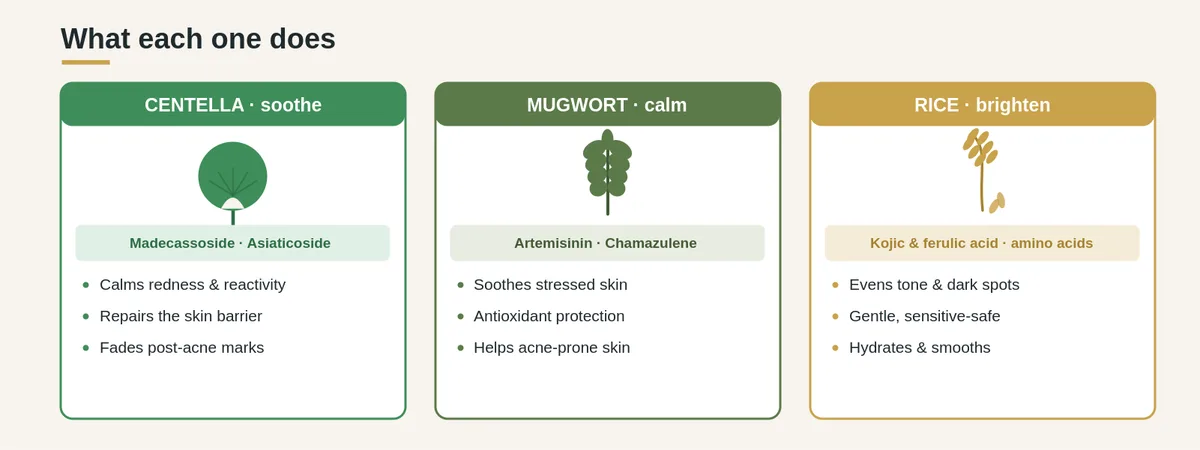
Its power comes from four triterpenoid compounds: madecassoside, asiaticoside, asiatic acid, and madecassic acid. Madecassoside is the anti-inflammatory hero, calming redness and reactivity by suppressing the inflammatory signalling that drives them. Asiaticoside does the rebuilding, stimulating fibroblasts to produce collagen and speeding the repair of damaged skin. Most clinical testing has focused on these two, which is why they appear by name on serious cica formulas.
In practice, centella does two things at once: it calms irritation now and repairs the barrier that let the irritation happen. Clinical studies show topical centella extract reduces transepidermal water loss and improves barrier-function scores in as little as four weeks. That combination makes it the go-to for skin that is over-exfoliated, sun-stressed, rosacea-prone, or just chronically reactive.
Who it suits: sensitive, red, or compromised skin, and anyone using stronger actives who wants a buffer against irritation. Look for it high on the ingredient list, or in concentrated ampoules, since a trace amount at the bottom of an INCI list does little.
Worth knowing what it is not. Centella entered the global mainstream through products like Dr. Jart+ Cicapair and COSRX, marketed as a cure-all, but its job is comfort and recovery, not deep cleaning. It will calm an angry breakout and fade the mark it leaves behind, yet it will not unclog pores or replace an actual acne treatment. Used for what it does best, it is one of the most reliable soothing ingredients in skincare.
Mugwort: the calming antioxidant
Mugwort, known as ssuk in Korean and labelled artemisia on packaging, is woven into Korean culture in a way the other two are not. It appears in teas, soups, rice cakes, and the steaming baths of the jjimjilbang, and it carries near-revered status in traditional Hanbang medicine. Koreans sometimes call it the Korean tea tree for its soothing, clarifying effect on skin.
Its skincare value rests on a dense mix of antioxidants and soothing compounds: chamazulene for antioxidant defence, artemisinin for its anti-inflammatory action, plus vitamins A, C, and E and a range of minerals. That profile makes mugwort a quiet multitasker, calming redness and irritation, helping acne-prone and congested skin through mild antibacterial activity, and protecting against the environmental stress that ages skin early.
Honesty matters here, and it is part of why this guide is worth trusting. Mugwort has centuries of traditional use and promising Korean cell-based studies, including work showing fermented mugwort supporting barrier formation and regeneration, but its rigorous clinical evidence is thinner than centella's. Treat it as an excellent soothing antioxidant rather than a proven anti-ager, and you will not be disappointed. It pairs beautifully with centella, which is why so many Korean lines combine the two.
Who it suits: stressed, dull, or breakout-prone skin that wants calming and antioxidant support. It is gentle enough for most sensitive skin, though anyone allergic to plants in the daisy family should patch test first.
Rice: the gentle brightener
Rice is the brightening member of the trio, and the one with the deepest place in everyday Korean and East Asian beauty ritual. The milky water left from rinsing rice has been used on skin and hair for generations, and modern Korean labs have turned that folk practice into stable, concentrated rice extracts and ferments.
Plain rice water already carries antioxidants like ferulic acid and gamma-oryzanol, amino acids that hydrate and repair, soothing allantoin, and light starches that smooth and soften. Fermentation takes it further. When rice is fermented into sake or saccharomyces and galactomyces filtrates, it produces kojic acid, a natural brightener that interrupts melanin production, alongside amino acids and peptides that mimic skin's own moisturising factors. Fermentation also shrinks the molecules so they absorb more easily.
The result is gentle, even-toning brightness. Cosmetic-science research has shown rice-derived compounds can reduce melanin meaningfully, on a level that rivals some synthetic brighteners but with a far softer touch. That gentleness is the point: rice is one of the few brighteners that suits people who react to vitamin C or niacinamide, which makes it a safe entry into tone correction for sensitive skin.
Who it suits: dull, uneven, or sun-marked skin, and sensitive types who want brightening without the sting of stronger acids. It layers well with niacinamide, hyaluronic acid, and ginseng.
A note on the DIY trend: the kitchen version, plain rinse water on the skin, is gentle and harmless, but it is unstandardised and spoils quickly. Commercial Korean rice toners and essences use purified, concentrated, properly preserved extracts that are more potent and far more stable, which is why brands like Beauty of Joseon and I'm From built whole lines around them. Either way, rice rewards patience: most people see brighter, more even skin after two to four weeks of consistent use, not overnight.
At a glance
| Ingredient | Korean name | Hero actives | Best for |
|---|---|---|---|
| Centella (cica) | Byeolpul (병풀) | Madecassoside, asiaticoside | Redness, barrier repair, post-acne marks |
| Mugwort | Ssuk (쑥) | Artemisinin, chamazulene, vitamins | Stressed, congested, acne-prone skin |
| Rice | Ssal (쌀) | Kojic & ferulic acid, amino acids | Dullness, uneven tone, dark spots |
How to use all three together
You do not need to choose one. These three cover different jobs, so they layer rather than compete. A simple approach: cleanse, then apply the thinnest product first. A mugwort or centella toner or essence sets a calm base, a centella serum or ampoule does the repair work, a rice essence adds brightening and hydration, and a moisturiser seals everything in. If your skin is reactive, lead with centella and mugwort and add rice once things settle.
Two practical rules keep this from going wrong. First, concentration beats novelty: a well-dosed centella ampoule outperforms five products that each list the plant near the end of their INCI. Second, introduce one new active at a time so you can tell what is actually working. None of these three is harsh, but layering everything at once still makes troubleshooting impossible.
The next generation: from extract to exosome
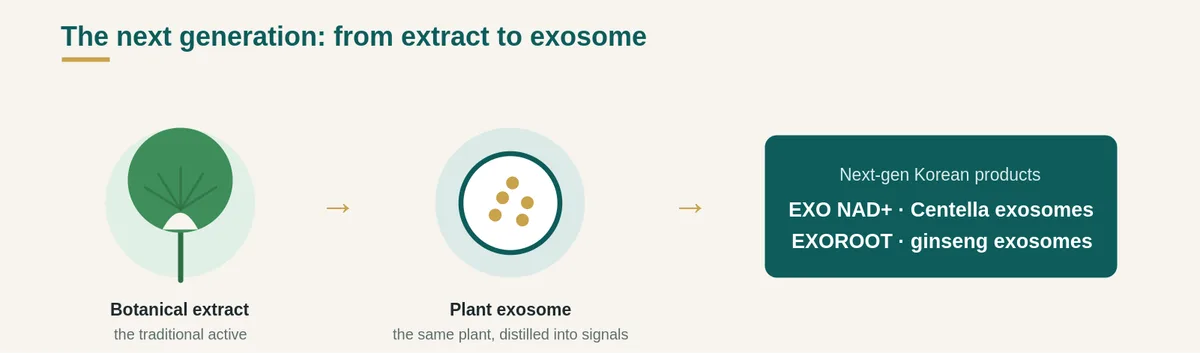
Korean labs rarely leave a good ingredient alone, and the newest chapter for these botanicals is the plant exosome. Instead of using a whole-plant extract, researchers isolate exosomes, the tiny signalling vesicles a plant's cells use to communicate, and deliver those concentrated signals to skin. It is the same botanical heritage, distilled into a more targeted form.
This is where the traditional and the cutting-edge meet. Next-generation Korean products such as EXO NAD+, which is built on Centella Asiatica exosomes among its plant sources, and EXOROOT, which uses ginseng exosomes for the scalp, carry the same plants featured here into clinic-grade treatments. If you want the deeper story on how these plant signals work, it is worth reading how plant and human exosomes differ.
What these ingredients can't do
Plant-based does not mean miracle, and managing expectations is part of using these well. None of the three is a substitute for sunscreen, which remains the single most effective anti-ageing and anti-pigmentation step in any routine. Rice can fade existing dark spots gently, but without daily SPF the sun replaces them faster than rice removes them.
They also will not restructure deep wrinkles or treat active cystic acne. Centella supports collagen and mugwort offers antioxidant protection, but both work at the level of comfort, barrier, and prevention rather than dramatic resurfacing. If your goal is significant wrinkle reduction or clearing persistent acne, these belong alongside stronger actives or a dermatologist's plan, not in place of them. Their strength is everyday resilience: calmer, stronger, more even skin that handles life better.
The takeaway
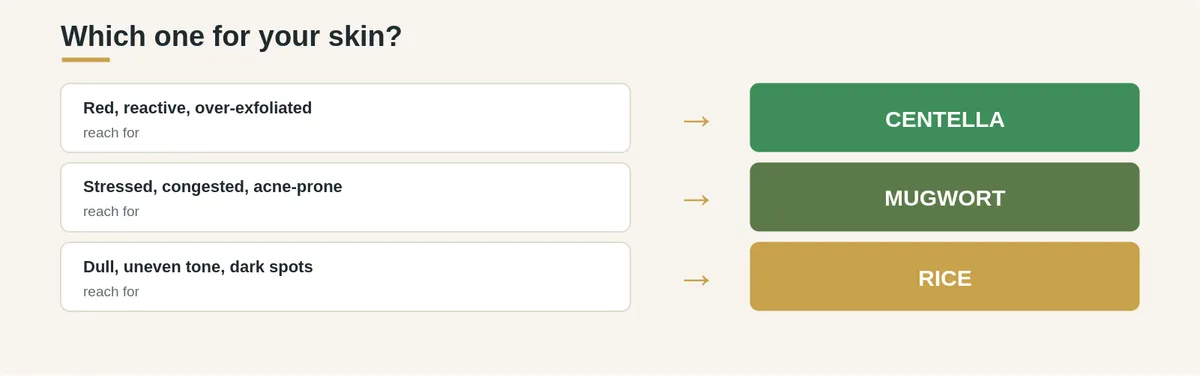
Centella, mugwort, and rice endure for a reason: they are gentle, they are versatile, and two of the three are genuinely backed by research rather than folklore alone. Reach for centella when your skin is red or reactive, mugwort when it is stressed or congested, and rice when it looks dull or uneven. Match the plant to the concern, respect concentration over hype, and these three can carry most routines on their own.
Building a Korean routine around these ingredients? It pairs naturally with the wider shift toward simpler, smarter K-beauty. See how Seoul's skip-care movement is rewriting the 10-step routine.