
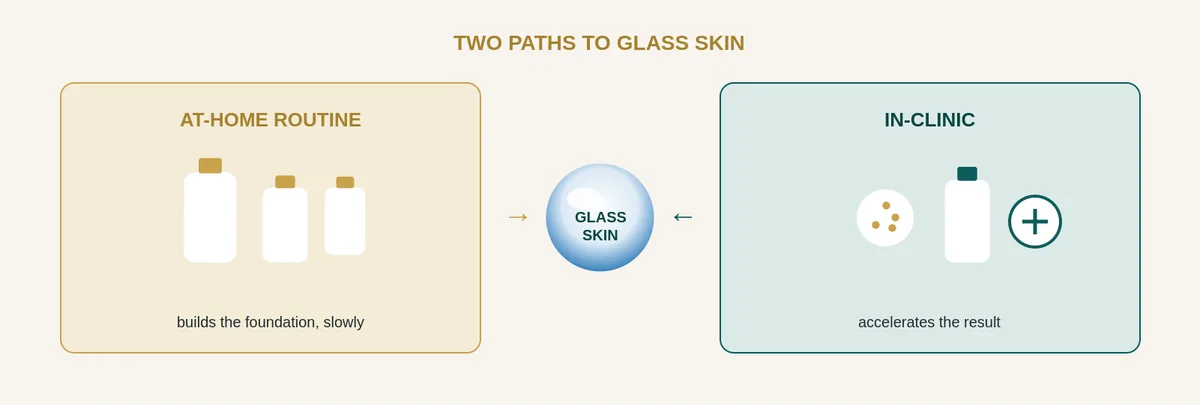
Glass skin is the most chased look in beauty: a complexion so smooth, even, and luminous it seems to reflect light like polished glass. The Korean term is yuri pibu, and the whole K-beauty world, from ten-step routines to Gangnam clinics, is built around getting there. But the question nobody answers honestly is the most important one: can you actually achieve it, and does it come from a bottle or a clinic chair?
The truth is that both play a role, and neither is the full story. This is the honest guide to what an at-home routine genuinely delivers, what a clinic adds on top, where genetics draw the line, and how to combine the two for the best version of your own skin.
First, the honest part
Glass skin is a camera-friendly ideal, not a medical guarantee. Good lighting and filters exaggerate it constantly, and the wet, poreless perfection you see online is rarely what that person looks like in daylight. More importantly, some of it is simply genetic. Pore size is largely inherited, and while you can make pores look smaller by keeping them clear and the skin smooth, you cannot permanently shrink them. Age, skin type, and conditions like rosacea or hormonal acne also set an individual ceiling.
None of that means the look is out of reach. What you can genuinely improve, and dramatically, is the three things that actually create the glass effect: smoothness of texture, evenness of tone, and the hydrated, light-reflecting quality of the surface. Set the goal as your best, healthiest skin rather than a filtered fantasy, and glass skin becomes an achievable project instead of a frustration. Anyone promising instant, permanent, poreless perfection is selling an illusion.
Path one: the at-home routine
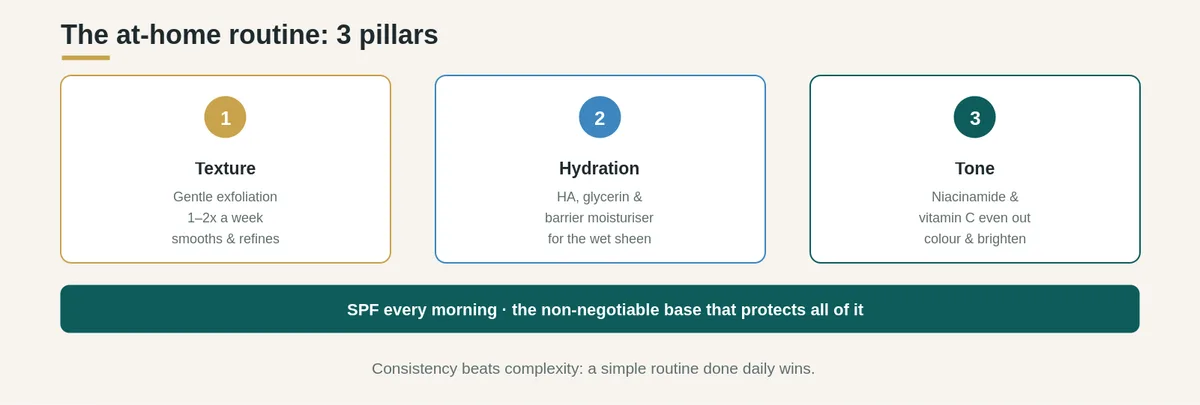
The foundation of glass skin is built at home, and it rests on three pillars. The first is texture: gentle exfoliation once or twice a week clears the dead-cell buildup that makes skin look dull and rough, so it reflects light evenly. Use a chemical exfoliant suited to your skin, salicylic acid for congestion, glycolic for dullness, or gentle lactic or mandelic acid for sensitive skin, and never overdo it, because over-exfoliation is the fastest way to wreck the barrier you are trying to build.
The second pillar is hydration, which is where the literal sheen comes from. Layer humectants like hyaluronic acid and glycerin onto slightly damp skin, then seal with a barrier-supporting moisturiser rich in ceramides. The third is tone: niacinamide regulates oil and improves the look of pores, while vitamin C brightens and evens out colour over time. Retinol is optional but accelerates texture and collagen if your skin tolerates it.
Two rules make or break the routine. Sunscreen every morning is non-negotiable, because UV breaks down collagen and drives the pigmentation that destroys the glass effect faster than any serum can build it. And consistency beats complexity: a simple four-or-five-step routine done daily for months will outperform an elaborate one done sporadically. If you want the ingredient detail, our guide to centella, mugwort and rice covers the gentle Korean actives that anchor this kind of routine, and the skip-care approach explains why fewer, better steps win.
Path two: the clinic
A routine can take you a long way, but it has limits. It works slowly, and it cannot fully resolve deep pigmentation, stubborn texture, or the appearance of large pores. This is where Korean clinics come in, and why beauty tourists fly to Seoul for treatments that move them much closer to the look in weeks rather than months.
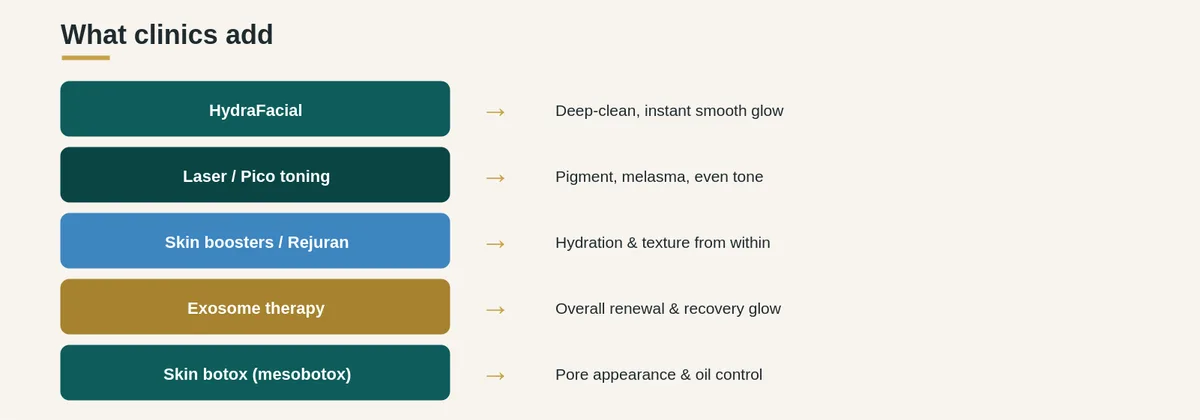
The menu is broad. A HydraFacial deep-cleans and resurfaces for an instant smooth glow. Laser and Pico toning target pigmentation, melasma, and uneven tone, the things topicals struggle with most. Skin boosters like Rejuran and hyaluronic-acid injectables deliver hydration and texture improvement from within the skin rather than the surface. Exosome therapy signals overall renewal and recovery, and is often layered after other treatments for added glow. And so-called skin botox, or mesobotox, micro-injects botulinum toxin near the surface to temporarily tighten pore appearance and reduce oiliness for that polished finish.
Crucially, even the most advanced clinic treatment still needs an at-home routine to support and maintain it. The clinic accelerates; your daily habits hold the result. If you want to understand the regenerative side of that menu, our guide to Rejuran, exosomes and skin boosters breaks down which does what.
Routine vs clinic, side by side
| At-home routine | In-clinic treatments | |
|---|---|---|
| Cost | Low, ongoing | Higher, per session or course |
| Speed | Slow; weeks to months | Faster; some results same day |
| What it does best | Builds & maintains the foundation | Fixes what topicals can't reach |
| Downside | Limited on deep pigment & pores | Needs upkeep; needs a routine too |
| Who it's for | Everyone, as the base | Boosting results or stubborn concerns |
The honest verdict: do both
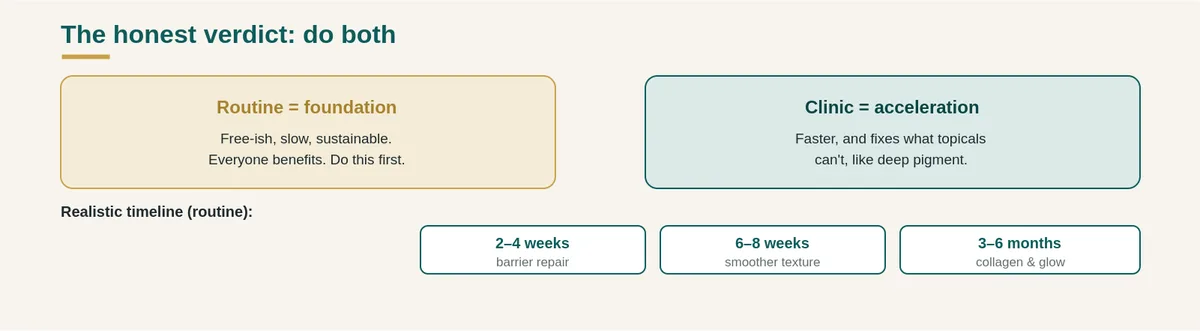
The framing of routine versus clinic is slightly false, because the best results come from treating them as partners. Your routine is the foundation: low-cost, sustainable, and something everyone benefits from, which is why it should always come first. The clinic is acceleration: faster, and able to fix the specific things a routine cannot, but most effective when it sits on top of healthy, well-maintained skin rather than replacing it.
Expectations should be realistic about timing, too. With a consistent routine, barrier health improves in two to four weeks, visible texture changes show around six to eight weeks, and the deeper collagen and glow benefits build over three to six months. Real transformation is six to twelve months of work. Clinic treatments shortcut parts of that, but nothing meaningful happens in three days, despite what the before-and-afters imply.
Where to start, by skin and budget
If you are new to all of this, start with the routine and give it three months before judging it; most people are surprised how far hydration, gentle exfoliation, tone correction, and daily SPF take them on their own. If your main barrier is something topical care struggles with, deep pigment, melasma, acne scarring, or visibly large pores, a clinic consultation is worth it, and laser toning or skin boosters will likely do more than another serum. If budget allows and you want the fastest, most complete result, the combination, a solid daily routine plus a targeted in-clinic course, is what the people with genuinely glassy skin are almost always doing.
And if your end goal is that lit-from-within idol look specifically, remember it is mostly skin quality with light makeup on top; our K-pop idol glow guide shows how the makeup side finishes the job.
What quietly sabotages glass skin
Plenty of people follow a good routine and still never see the glow, usually because of a handful of avoidable habits. The biggest is over-exfoliation: scrubbing or acid-ing daily in pursuit of smoothness strips the barrier, triggers inflammation, and leaves skin red and rough, the opposite of glassy. Skipping sunscreen is the other major one, since UV undoes collagen and pigmentation work continuously. Harsh, stripping cleansers, piling on too many actives at once, and chasing every new product also do more harm than good. If your skin feels tight after cleansing, that is a warning sign, not a sign of clean skin.
It is also worth remembering that glass skin is partly an inside job. Chronic stress raises cortisol, which increases oil and inflammation; poor sleep shows on the face within days; and dehydration and a nutrient-poor diet flatten the glow no serum can restore. Sweat left sitting on the skin after a workout clogs pores, so rinse soon after. None of this replaces a routine, but a routine fighting against bad sleep, high stress, and no sun protection is a routine working at half power.
The takeaway
Glass skin is real, but it is skin quality, not magic, and it is partly capped by genetics no routine can rewrite. The honest path is to build the foundation at home with texture, hydration, tone, and relentless sunscreen, then use clinic treatments to accelerate and to fix what topicals cannot. Set a realistic target of your best skin rather than a filtered ideal, give it months not days, and the glow you are chasing stops being a trend and becomes your actual face.