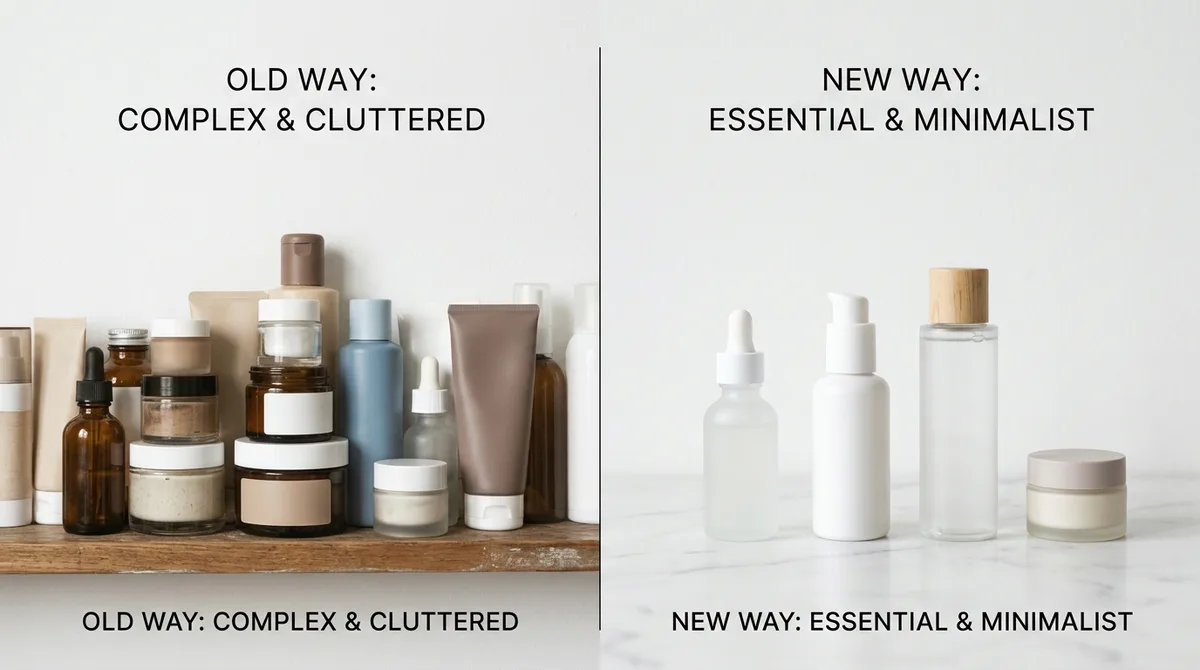
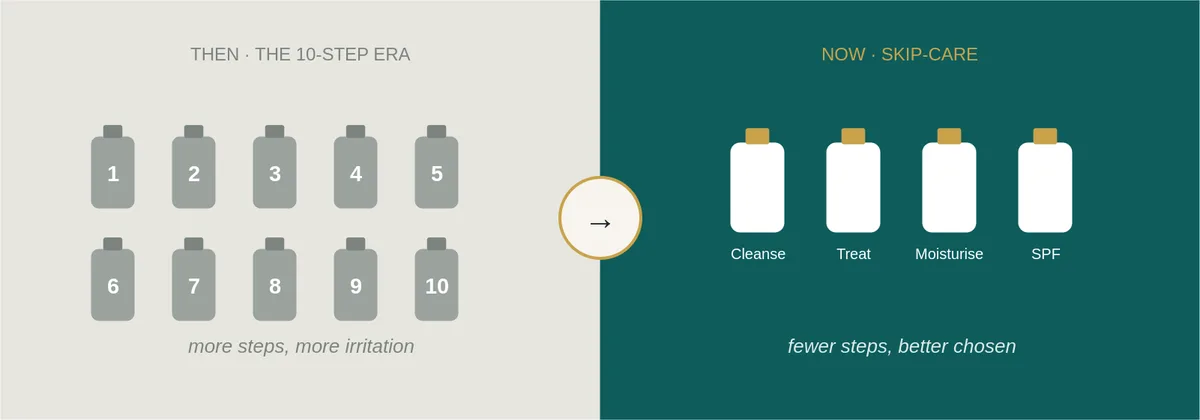
The 10-step Korean skincare routine is the thing that made K-beauty famous. Cleanse, double cleanse, exfoliate, tone, essence, serum, sheet mask, eye cream, moisturiser, sunscreen, repeated like a catechism in every magazine that discovered Seoul around 2015. It sold a lot of product. There is just one problem: most Koreans never actually did it, and the ones who tried have largely stopped.
In 2026, the routine that defines Korean skincare is the opposite of elaborate. It is short, deliberate, and built around the skin barrier rather than the bathroom shelf. Koreans call it skip-care or skinimalism, and increasingly just treat it as common sense. Here is what really happened to the 10-step routine, and what replaced it.
The 10-step routine was always a myth
Start with the uncomfortable truth: the 10-step routine was largely a Western interpretation of the Korean market, not a daily Korean reality. Korea has an enormous range of product categories, toners, essences, ampoules, serums, sheet masks, so a writer could line them up and call the lineup a routine. For most Korean consumers it was a menu, not a mandate. You pick what your skin needs that day, not all of it every night.
The framing took off internationally because it was vivid and aspirational, and because it gave brands ten things to sell instead of three. Popularised in the West around 2015, largely through Soko Glam's Charlotte Cho, the 10-step idea was a clever way to explain the depth of the Korean market to outsiders. It was never meant as a nightly checklist, but that nuance got lost in translation. The notion that Korean women were dutifully layering ten products every evening was always more theatre than fact.
The numbers bear this out. A 2025 Korean beauty survey found that 67% of women aged 20 to 35 use five or fewer products in their daily routine. The elaborate version was always more aspirational than real, a glass-skin fantasy sold to people who, ironically, would have gotten clearer skin with half the steps.
Why even the maximalists scaled back
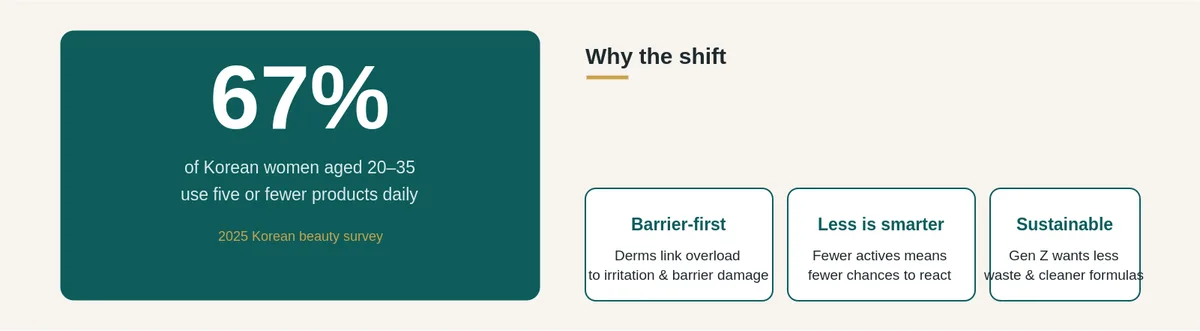
Two things pushed the shift from more to less. The first is barrier science. Dermatologists in Korea began seeing a rise in compromised skin barriers, inflammation, and sensitisation, much of it self-inflicted by people layering acids, retinoids, vitamin C, and a dozen actives in pursuit of glass skin. More products simply mean more chances to irritate and overload the skin. The minimalist approach turned out to be the clinically smarter one.
The second is a generational shift. Korea's Gen Z is environmentally conscious and skeptical of overconsumption, wary of a shelf full of half-used bottles destined for landfill. Buying fewer, better products is both kinder to skin and easier to justify. Add the simple reality that nobody has time for ten steps twice a day, and the maximalist routine was always going to lose.
The key word in all of this is intentional. Skip-care is not laziness or neglect, and it is not about owning as little as possible for its own sake. It is selection by demand rather than reduction by default. A poorly chosen cleanser or a cream that fights your skin type defeats the entire point. Fewer products only works when the few you keep are the right ones.
Myth versus reality
| The myth | What Koreans actually do |
|---|---|
| Ten products, every night | Three to five, chosen for their skin |
| More steps means better skin | The right steps means better skin |
| Layer every essence and ampoule | One multitasking treatment per concern |
| Follow a fixed sequence | Adjust by season, stress, and skin state |
| Buy the full set | Buy fewer, better-formulated products |
What Koreans actually do in 2026
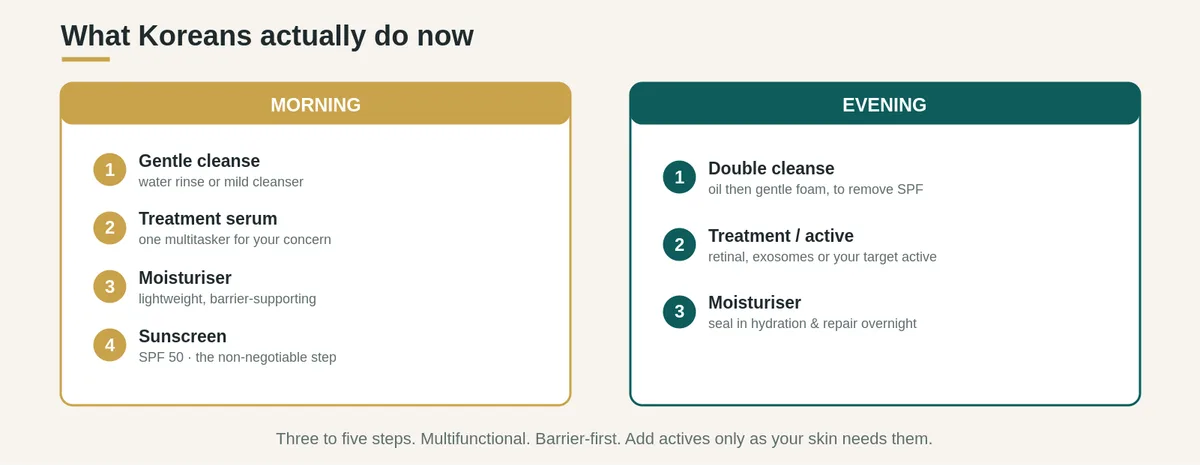
Strip the marketing away and the modern Korean routine settles into three to five steps built on three essentials: cleanse, moisturise, and protect. Everything else is optional and added only when a specific concern calls for it.
In the morning, many Korean dermatologists suggest a water rinse or a very mild cleanser, since the skin was already cleaned the night before. Then a single treatment serum chosen for your main concern, a lightweight barrier-supporting moisturiser, and sunscreen, which is the one step nobody skips. At night the routine opens with a double cleanse, an oil or balm followed by a gentle foam, to lift the day's sunscreen and grime. After that comes a targeted treatment, whether a retinal, an exosome treatment, or whatever active your skin actually needs, then a moisturiser to seal in repair overnight.
The thread running through all of it is multifunctionality. Instead of stacking a hydrating toner, a brightening essence, and a separate firming serum, the modern approach reaches for one well-formulated product that does several of those jobs at once. Fewer steps, but each step earning its place.
The steps that quietly disappeared
Skinimalism did not delete the 10-step routine so much as quietly retire the steps that were never doing much. Daily chemical exfoliation was one of the first to go; once dermatologists connected aggressive acids to barrier damage, exfoliating dropped to once or twice a week at most, and many people stopped entirely. Standalone toners used purely to wipe the face became redundant once gentler cleansers did the job, and hydrating toners merged into essences.
The line between essence, serum, and ampoule, three near-identical steps that confused everyone, has largely collapsed into a single treatment step. The dedicated eye cream is now optional, since a good moisturiser usually works around the eyes too. Sheet masks shifted from a nightly ritual to an occasional treat. What remains is the load-bearing core: cleanse, treat, moisturise, protect. The trimming was not cosmetic; it removed the steps most likely to irritate while keeping the ones that actually build healthy skin.
So is K-beauty over?
Not remotely, and this is the part the headlines miss. Skinimalism does not replace K-beauty; it is K-beauty maturing. Korean formulas have always been designed to work together with minimal friction, with concentrated actives and compatible textures, which is precisely what makes a short routine effective rather than lazy. The industry simply shifted its emphasis from performance-through-layering to performance-through-precision. The science got better, so the routine got shorter.
The rise of the all-in-one
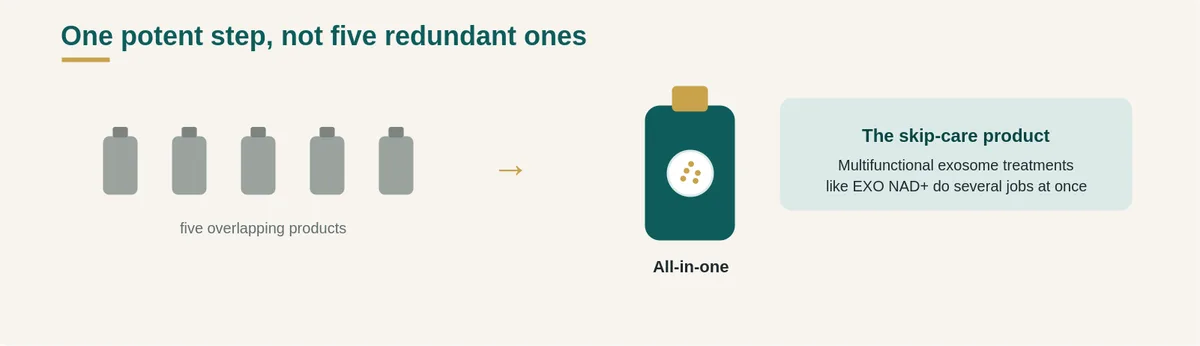
This is where skip-care meets the cutting edge of Korean formulation. If the goal is one potent step instead of five redundant ones, the product has to do more. That is exactly the direction Korean labs have moved, toward concentrated, multitasking treatments that fold hydration, repair, brightening, and anti-ageing into a single application.
Next-generation actives fit this philosophy neatly. All-in-one exosome treatments such as EXO NAD+, which combines plant exosomes, peptides, and skin-rejuvenating actives in one solution, are built to replace a whole tray of single-purpose products with one targeted step. It is the skip-care principle taken to its logical end: not doing less to your skin, but doing more with less. If you want to understand the actives driving this, it is worth reading the guide to PDRN, exosomes, and polynucleotides.
How to switch without wrecking your skin
If you are coming from a crowded routine, do not strip everything overnight. Pull back to the three essentials first, cleanse, moisturise, and sunscreen, and let your skin settle for a week or two. Then reintroduce one treatment at a time so you can actually tell what is helping. This is the same discipline that makes skip-care work in the first place: one variable at a time, judged on results.
Give any new active six to eight weeks before deciding whether it works, because skin renews on its own slow schedule and nothing meaningful shows up in three days. And keep the realistic expectations a good routine deserves. Skinimalism will not fix severe inflammatory acne, rosacea, or a chronic skin condition; those still need a dermatologist. What it will do is give most people calmer, stronger, more resilient skin with a fraction of the effort and cost.
The takeaway
The 10-step routine is not dead because Korean skincare failed. It is dead because Korean skincare grew up. The lesson the rest of the world is finally catching up to is the one Seoul arrived at years ago: skin does not want more, it wants the right things, applied consistently, chosen for what it actually needs. Three to five intentional steps, a non-negotiable sunscreen, and products potent enough to multitask will outperform a ten-bottle ritual almost every time.
Ready to rebuild around fewer, smarter ingredients? Start with the plants that anchor most modern Korean routines: centella, mugwort, and rice.